
Our Rock
What an astronaut’s Easter message reveals about the napkins we can’t see from inside them.

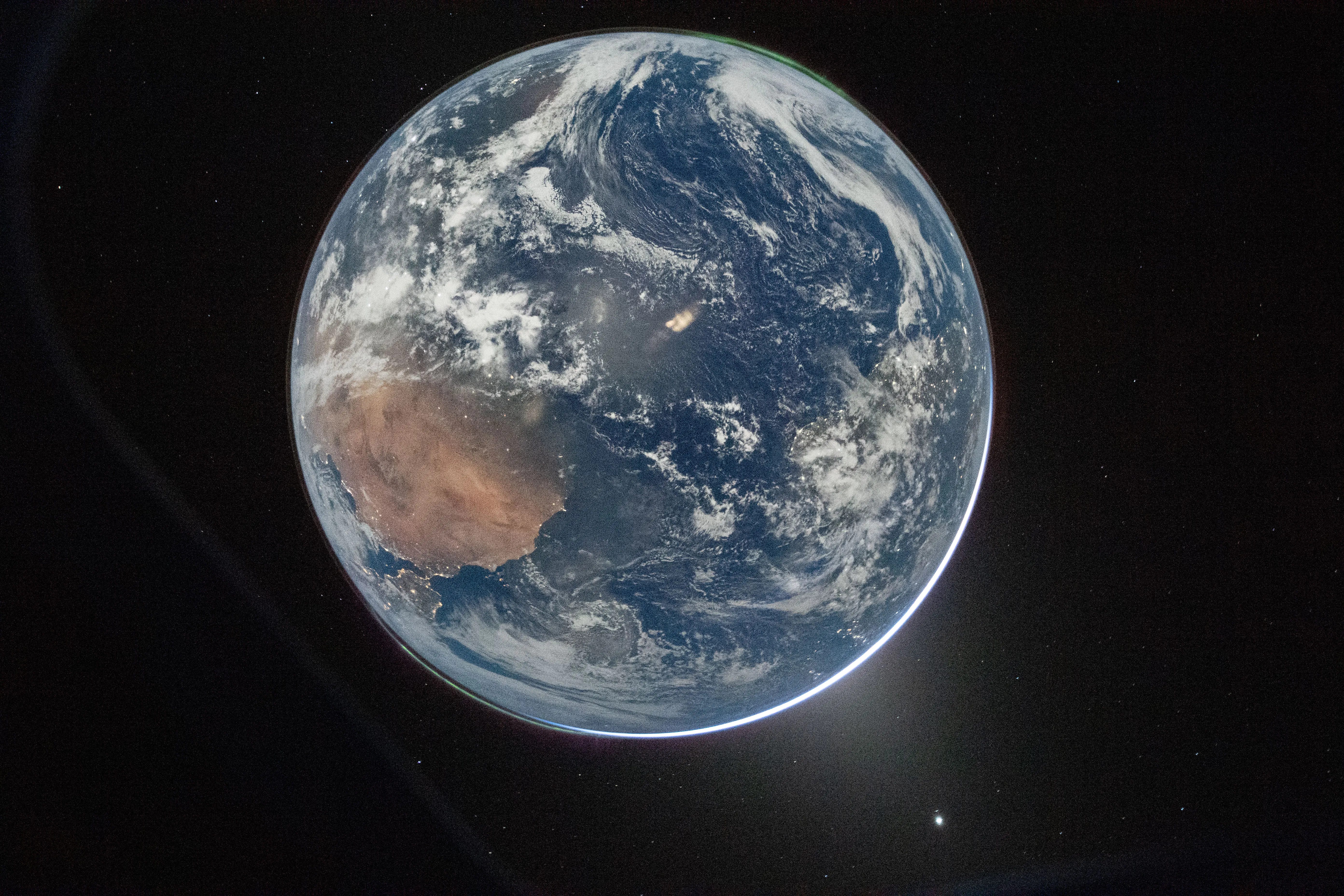
On Easter Sunday 2026, Victor Glover was floating between Earth and the Moon. He was one of four astronauts aboard Artemis II, the first crewed mission to leave Earth orbit in more than fifty years. Somewhere past the point where our planet stops looking like ground and starts looking like a marble, he recorded a message.
“This is an opportunity for us to remember where we are, who we are, and that we are the same thing, and that we’ve gotta get through this together.”
A man looked back at the only home our species has ever known and said what every astronaut eventually says in some form. The borders disappear. The arguments shrink. What remains is the rock.
Why does seeing the Earth from far enough away make some human frameworks look trivial and others look truer?
The View from Out There
Astronauts call it the overview effect. The term sounds clinical, but the experience it describes is not. Every person who has seen Earth from sufficient distance reports a version of the same shift. The political map they carried in their head dissolves. The planet becomes a single living system, breathing and turning in a darkness that does not care about any of the stories we tell on its surface.
Glover was not the first to feel this. Edgar Mitchell came back from the Moon and spent the rest of his life trying to articulate what had happened to him. The word he kept reaching for was “interconnectedness.” Mitchell had a PhD in aeronautics from MIT. He was not given to mysticism. But the view from out there broke something open that his training had no language for.
The overview effect does not deliver new information. Everyone already knows Earth is round, that borders are political constructions, that the atmosphere is thin. You can learn all of this in a sixth-grade classroom. The knowledge changes nothing. The experience changes everything.
Why does physical distance do what intellectual understanding cannot? Why do astronauts so often return sounding more spiritual than technical? Why does seeing more reality tend to reduce ideological certainty rather than increase it?
Glover delivered his message on Easter. He is a man of faith. The holiday that frames resurrection and renewal was the context for his broadcast. And the view did not strip him of that context. It deepened it. “We are the same thing” is both a statement about planetary unity visible from space and, for Glover, a claim about shared creation. He was inside one of humanity’s oldest frameworks and seeing beyond all of them at the same time.
That combination is worth sitting inside before trying to explain it.
The Napkin You Can’t See from Inside It
In Napkin Theory, reality is a table. We cannot perceive the table directly. We lay napkins on it, frameworks that compress the overwhelming complexity of nature into something we can navigate. Nations are napkins. Religions are napkins. Economic systems, cultural identities, family mythologies. They rest on the table. They take shape from it. But they are not it.
The problem is not that we use napkins. We have to. A human being cannot operate on the bare table. Narratives give us roles to play, rules to follow, meaning to make. The problem is that we forget they are napkins. We mistake the framework for the reality underneath.
From the surface of the Earth, this forgetting is nearly impossible to avoid. Every napkin you inhabit looks like the world. Your country’s border looks like geography. Your culture’s values look like universal truths. The napkin is so close to your face that you cannot see its edges.
From 240,000 miles away, you can.
Instruments Looking Back at Themselves
Your eyes catch 0.0035% of the electromagnetic spectrum. Your nervous system evolved not to show you what is real but to keep you alive long enough to reproduce. You are an assembly of biological instruments tuned to a very specific slice of nature.
Glover carried those same instruments to the Moon. Nothing about his biology changed. What changed was the distance. It let him see the instrument from outside the instrument.
You cannot examine a napkin you are standing inside by thinking harder within it. You need a different vantage point. Travel offers one method. Comparative theology offers another. Leaving the planet offers the most literal version of the move. You step far enough away that the napkin becomes visible as a napkin, not as reality itself.
What Held
The overview effect did not dissolve Glover’s faith. It clarified it. He was not reporting from a neutral vantage. He was a believer looking back at the planet where his tradition was born and finding that the widest possible view confirmed rather than threatened what he already carried.
Not every framework survives that test. Most napkins work only at close range. They organize experience within specific boundaries, but they fracture when the boundaries expand. The frameworks that hold at distance, the ones that still cohere when you zoom out far enough to see their edges, are touching something deeper than the narrative itself.
Glover’s faith held. His national identity, his political affiliations, whatever arguments he carried from the ground, those are not what he broadcast from between worlds. What survived the distance was the simplest claim. We are the same thing.
The Broadcast
The dominant logic of our attention economy does not reward or select for this kind of message. In the economy most of us inhabit, your clicks are modeled, your preferences clustered, your next action predicted by what people who resemble you did before. The architecture points at conversion. It is designed to get you to do something.
Glover’s message pointed at coherence. It asked nothing of the listener except to remember.
One of Many
In the poem that opens one of the early Napkin Theory essays, there is a line that has stayed with me since I first wrote it.
“Our rock is one of many.”
Glover saw that. Not as metaphor. He saw the rock. One rock, hanging in nothing. Every war we have ever fought happened on its surface. Every love story, every nation that rose and crumbled. All of it on a single rock that does not know our names.
People hear the overview perspective and feel nihilism. But that is not what Glover said. He said we are the same thing. The smallness of the rock is what makes the connection between the people on it so staggering. We have nowhere else to go. We have no one else to be.
The Edges
Most of us will never leave Earth orbit. But the move Glover made is available to anyone.
Every napkin we inhabit has edges. You can find them without a spacecraft. You find them when you live inside a different culture long enough to feel your own assumptions become visible. You find them when a conversation with someone who sees the world completely differently makes your framework shimmer for a moment, translucent instead of solid.
The overview effect is not about altitude. It is about distance. Enough distance from your own framework to see it as a framework. Glover did not discard his faith at the Moon. He saw it more clearly. He found it held.
The question is not whether your napkins are real. They organize your days, your relationships, your sense of what matters. The question is whether they hold when tested against a wider view.
Glover pulled back farther than almost anyone alive. What he found was not emptiness. It was connection. One rock, turning slowly, carrying all of us.