The Interplay of Napkins

The crowd didn’t move. No moshing, no chaos, just stillness. A thousand people stood shoulder to shoulder, faces lit by the stage, as Marilyn Manson rasped through songs written thirty years ago. From the outside it looked apathetic. But it wasn’t. It was therapy.
You could feel it in the air. Rage, grief, shame, the orphaned emotions polite culture keeps locked in the basement. This wasn’t rebellion. It was release. Each lyric gave shape to what the default world forbids.
Watching him, a thought cut through. If a glitch revealed he was lip-syncing, the whole thing would collapse.
Because Manson isn’t an entertainer. He’s an architect of coherence. His power depends on authenticity. The moment expression stops matching essence, the structure evaporates. The same rule governs every system of meaning. A company, a movement, a person. Once the outer form diverges from the inner resonance, it becomes a prop.
Authenticity, then, is not style but structural integrity. It is the alignment between what is expressed and what is true. The field, the vast table of consciousness beneath all napkins, recognizes vibration, not rhetoric.
As the set went on, it became clear that Manson’s napkin wasn’t meant to overthrow the default but to balance it. The concert was the counter-napkin made audible, a pressure valve for a culture too ordered to admit its shadow. His music gave the audience temporary permission to inhabit what they usually suppress. In that sense, the performance didn’t oppose the system. It steadied it.
Through that lens, you could see two orders overlapping. The default napkin and its counter. Each distorts reality in its own direction, one smoothing it into civility, the other amplifying what civility hides. Yet when these opposing distortions align, they create a fleeting window of resonance.
The field itself, the table of consciousness, is never warped. Only our napkins bend it. When distortions meet in the right way, they cancel just enough for the underlying order to shine through. That flash of coherence is what we call beauty, truth, catharsis. It isn’t correctness. It’s harmony among distortions.
That is why the music felt timeless. It wasn’t nostalgia. It was necessity.
And Manson isn’t unique in that. All music, across genres and centuries, performs the same act of translation. A folk song in a village, a jazz solo in a smoky bar, a symphony echoing through marble halls. All of them bridge the pure field of consciousness with the lived napkins of their listeners. Each note becomes a temporary thread between what is unconditioned and what is storied. That is why music never belongs solely to its creator. It belongs to the field itself, finding whatever frequency each listener needs to remember they are part of it.
The pattern appears across cultures of all sizes. In Salt Lake City, one of America’s most religiously ordered communities, a fierce punk rock scene erupted in the late 1970s and 1980s. Against the backdrop of Mormon culture, with its emphasis on conformity, clean living, and prescribed behavior, the aggression and chaos of punk provided necessary release. Bands played in basements and dive bars, giving voice to exactly what the dominant napkin forbade. Rage, rebellion, sexual energy, profanity, noise.
The scene wasn’t large, but it was intense. It had to be. The tighter the default napkin’s order, the more concentrated the counter-energy becomes. SLC punk wasn’t trying to destroy Mormon culture. It was metabolizing what that culture couldn’t contain. The kids in the pit weren’t lost. They were found, temporarily, in a napkin that let them express frequencies the default suppressed.
This interplay of narratives exists well beyond music. Japan’s yakuza perform at cultural scale. Outsiders see crime. Insiders recognize counter-order. Bound by ritual, hierarchy, and codes of reciprocity, they carry the energies the default napkin of Japanese civility cannot contain. During the 2011 tsunami, yakuza networks delivered food and fuel to stranded towns before the government mobilized. They acted where bureaucracy could not bend. Their existence, like Manson’s, keeps the broader system coherent by holding what the dominant order cannot express.
Every society and every psyche requires its counter-napkins, structures that metabolize the shadow instead of denying it. They are not acts of rebellion but of balance. Without them, the system collapses under its own pretense of purity.
For individuals, the same rule applies. To find one’s own napkin is to discover the work that resonates so deeply you would fight to keep doing it. That test reveals authenticity’s source. The activity that tunes your life to the field’s underlying rhythm.
But authenticity cannot be declared. It must be enacted. Manson’s presence on stage, night after night, is the napkin that represents his authenticity. A construct simply attacking the status quo would crumble under ridicule. Instead, his lyrics and performances express his truth through a lens that overlaps with the default narrative, creating the resonance that makes his counter-napkin coherent and authentic. The field recognizes genuine vibration, not rhetoric.
Manson has lived in that friction for decades. The ridicule that followed him wasn’t proof of failure. It was feedback, the sound of a system adjusting around a new coherence. Every authentic napkin disturbs the default. That disturbance is how the field recalibrates.
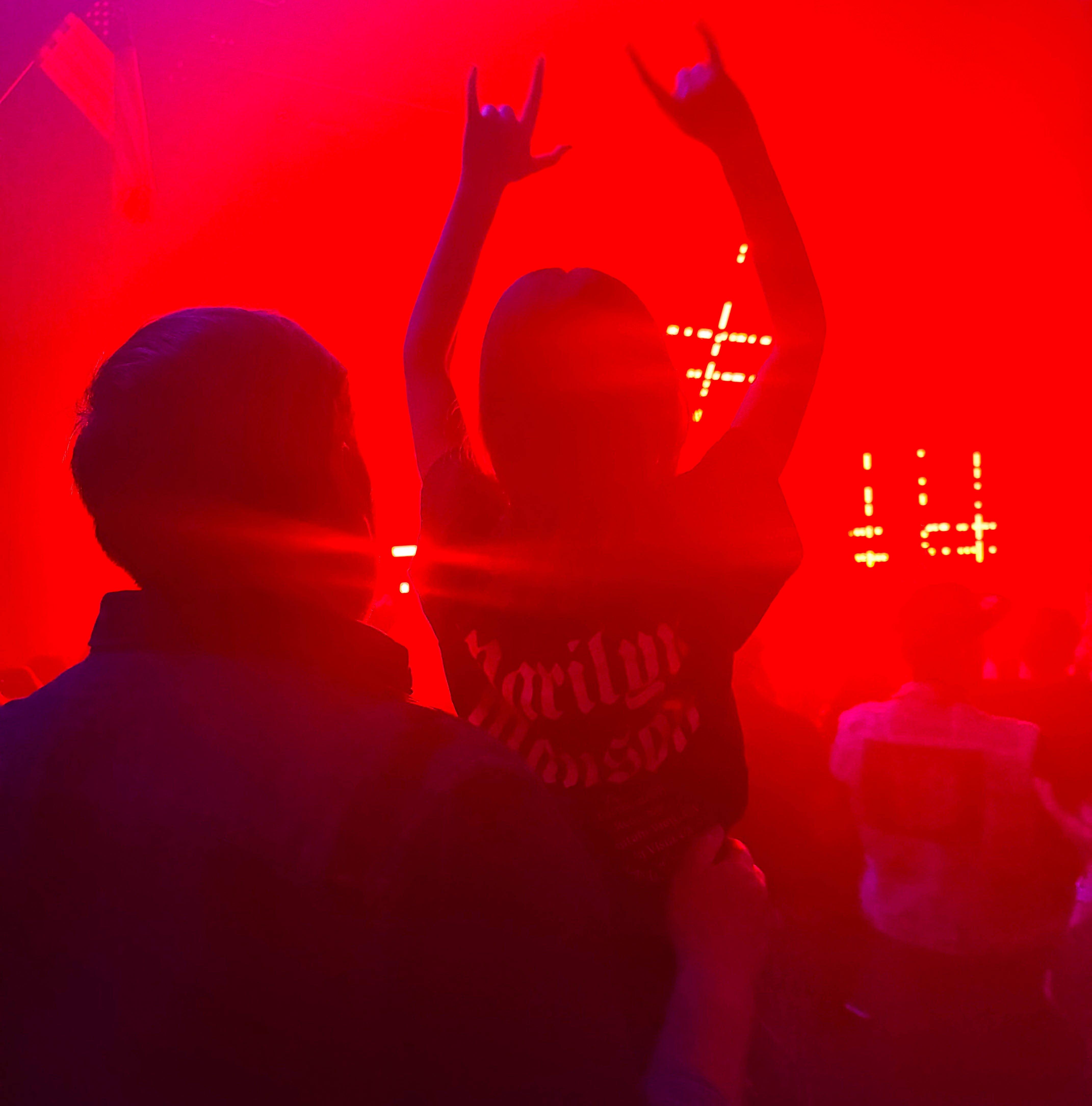
Before the night ended, a small symmetry caught my eye. A father and daughter beside each other, her first Manson show. Two generations absorbing the same frequency, learning where to place their own distortions. For a moment the lights on their faces blended into the glow from the stage, two lenses aligned.
Driving home, the metaphor stayed alive. Every car on the freeway wants to go faster, slower, somewhere else. The practice is simple. Hold your lane, your pace, your rhythm. The discipline isn’t defiance but coherence. Ridicule works the same way, the honking of a system trying to pull you back into its tempo. What matters is whether your motion is driven by fear or resonance.
As we traverse borders of narratives playing multiple characters, a universal truth persists. We are driven by coherence with something we do not fully understand yet always orient towards. Realizing we exist across many napkins simultaneously, and that counter-napkins balance the defaults to create resonance with a larger order, reveals how we might live authentically. The work is learning to trust the magnetism within us and crafting our compass to make sense of it. That is how we find our music.