
The Napkins That Feed Us

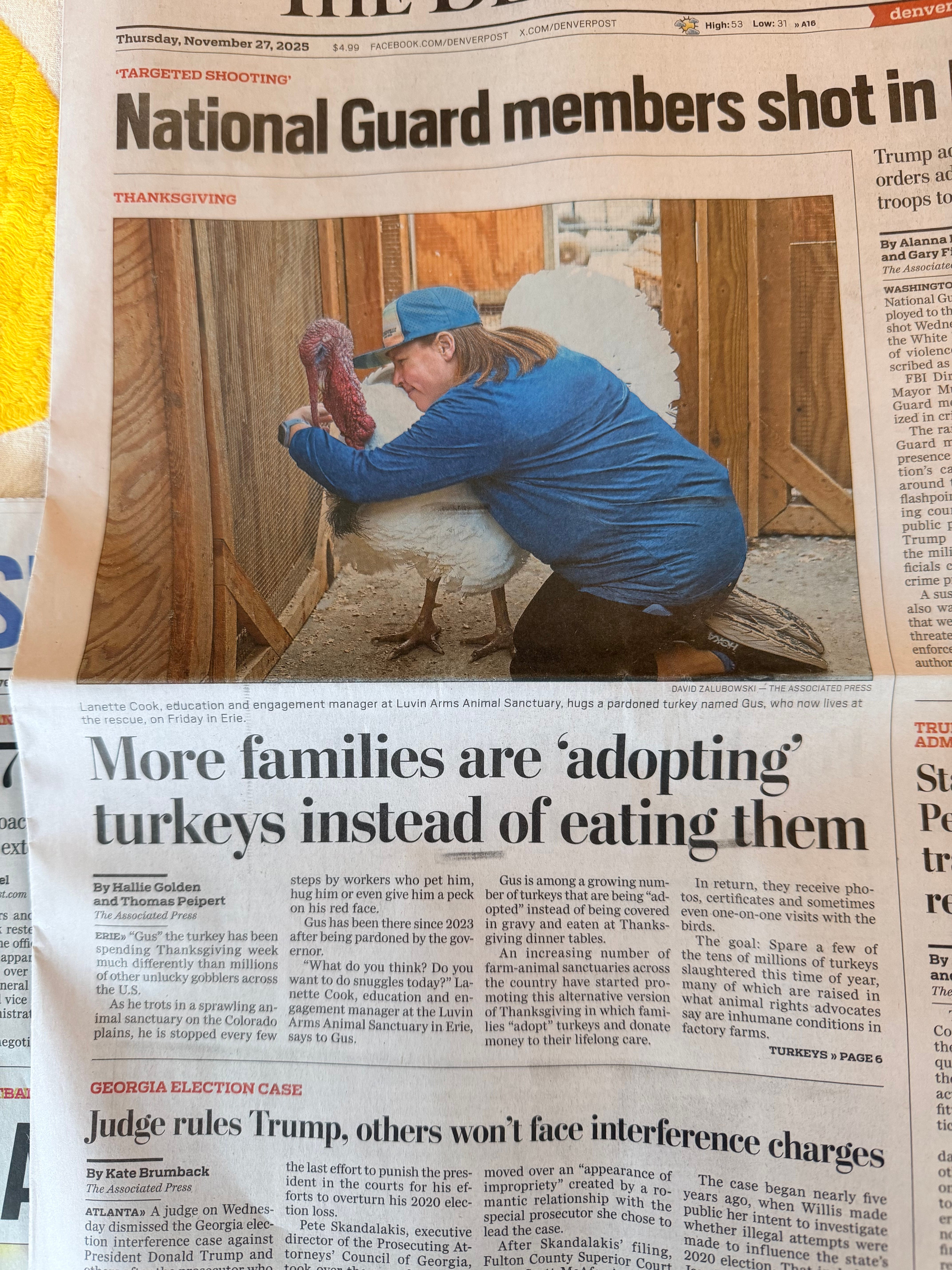
I’m holding today’s newspaper from my hotel on Thanksgiving morning. The front page of the Denver Post shows a woman hugging a pardoned turkey named Gus at an animal sanctuary. The headline reads “More families are ‘adopting’ turkeys instead of eating them.”
Above this heartwarming story, National Guard members shot in a targeted attack. Below it, Hobby Lobby’s Christmas sale at 50% off. Three different realities on a single page.
And here’s what strikes me. I’m reading this while my brother in law’s cooks the perfect turkey that’s been brining in his family recipe for the last 24 hours. I’m participating fully in the exact ritual this feel-good story offers as an alternative.
The article describes people who’ve inverted the entire Thanksgiving transaction. Instead of killing the turkey, they save it. Instead of eating it, they sponsor its care. Some even feature their adopted turkey’s photo on their Thanksgiving table where the roasted bird would traditionally sit.
The factual content has reversed completely. Dead to alive. Consumed to conserved. Plate to portrait.
And yet they’re getting the same thing from the holiday: family gathering, seasonal ritual, moral coherence, cultural belonging. We both call it Thanksgiving.
The narrative keeps feeding them even when they’re no longer eating the turkey.
That sentence reveals something profound about how human belief works. We’re not consuming stories for their factual content. We’re consuming them for what they give us. These are the roles they let us play and the identity they enable.
This is what I mean when I talk about napkins: the narrative frameworks we place on the table of reality. They feed us by giving us what we need, regardless of whether the facts beneath them stay constant or invert completely.
The Tool That Made Us Human
To understand why narratives survive despite changing facts, we need to understand what they actually are.
In A Tool Called Narrative, I introduced the metaphor of napkins on a table. Imagine nature, all of reality, as a giant table. We place napkins on that table: frameworks that organize the overwhelming complexity into something we can navigate.
We are ecosystems of tools. Eyes that translate light, ears that turn vibration into sound. But our most important tool isn’t physical. It’s cognitive. We make narratives.
Consider one of humanity’s oldest traceable narratives: The Cosmic Hunt. Versions of this myth appear across the Northern Hemisphere. The basic pattern is a hunter chases an animal into the sky, and they become constellations.
Look up at the night sky.

Without a framework, you see thousands of random points of light. It is overwhelming and unusable.
Now place the Cosmic Hunt napkin on that table. Suddenly those points organize into shapes. The randomness becomes a story. The story becomes a map. The map becomes a seasonal clock: when the hunter reaches this position, plant; when he reaches that position, harvest.
The narrative wasn’t accurate astronomy. But it was extraordinarily useful. It organized observational data in a way that could be remembered and acted upon. It turned chaos into coherence, and coherence into survival advantage.
This is what narratives do. They don’t primarily give us truth. They give us organization. They are compression algorithms for reality.
But, and this is crucial, all of these frameworks exist on the table of nature. As I’ve written before, our faculties evolved not to reveal complete truth but to detect enough of nature to survive in it. Our eyes catch only 0.0035 percent of the electromagnetic spectrum.
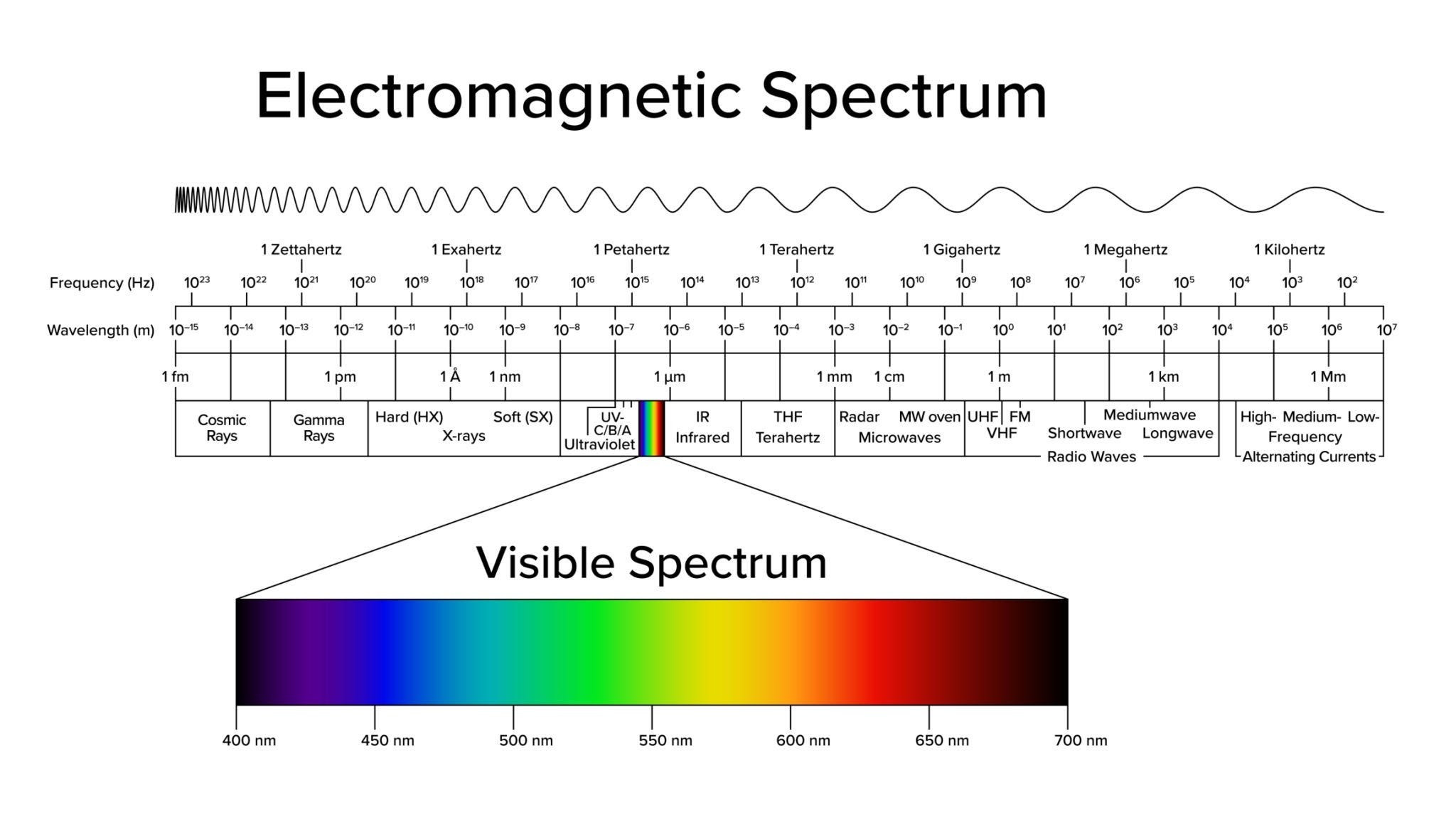
We can’t see most of the table we’re trying to make sense of.
Narratives must have some basis in the table, or they wouldn’t provide utility. The Cosmic Hunt worked because the stars actually do move in patterns. The story mapped onto something real, even if the interpretation as divine hunters was invented.
The selection pressure is utility, not truth. We naturally reach for narratives that feel satisfying rather than correct. We need frameworks that answer our questions in ways we can live with.
This Isn’t Just Ancient History
We do the exact same thing with our modern survival tools. Money, housing, holidays. The pattern hasn’t changed.
Consider an example playing out across Thanksgiving dinner tables.
Your parents bought a house at 28. Single income, high school diploma. They did everything right according to the narrative they inherited, and the narrative delivered.
You’re 35 with a graduate degree. You’ve been saving for seven years and still can’t afford a house. You did everything right according to the narrative you inherited, and it didn’t deliver.
Same table. Different stories.
Here’s where it gets interesting. Everyone sees this gap between promise and reality. What differs is the explanation people adopt. And if you look closely, people don’t choose the most accurate explanation. They choose the one that benefits them most.
Your father might say, “I worked hard and earned what I got. Today’s generation expects everything handed to them.”
This narrative gives your father something essential. It protects his identity as someone who earned his comfort rather than lucked into it. It gives him the role of self-made success. That’s powerful utility.
You might say, “The system is rigged. Wages have stagnated while costs have exploded. My parents’ generation pulled up the ladder.”
This narrative gives you something equally essential. It protects your identity as someone struggling not from personal failure but from systemic design. It gives you the role of victim of structural injustice. That’s also powerful utility.
Now imagine if your father adopted your narrative. Suddenly he’s not a hard worker; he’s someone who got lucky. His self-concept collapses. Imagine if you adopted his narrative. Suddenly you’re not a victim of a rigged system; you’re just inadequate.
Both role reversals leave you without dignity. So neither of you switches. You both stay inside the napkin that benefits you most, regardless of which explanation fits the economic data.
This isn’t weakness. This is the architecture of belief. We defend our narratives not because they’re accurate, but because we need the dignity they provide.
When the Benefits Stop Working
But what happens when the narrative stops delivering benefits? This is where the turkey adoption story becomes fascinating.
The traditional Thanksgiving role was simple: you prepared a turkey, gathered family, and participated in a national ritual of gratitude. It aligned with the cultural narrative: wholesome, unifying, American.
But the gap between the myth and the table widened. We learned about the violent aftermath of the 1621 feast. We learned about factory farming. The gap between “peaceful pilgrims” and “industrial slaughter” became too wide to bridge.
When that gap opens, you face a choice: abandon the holiday (and lose the connection) or modify the role.
The turkey adoption movement isn’t a rejection of Thanksgiving. It’s an adaptation.
Old role: Grateful provider feeding family through traditional abundance.
New role: Compassionate actor saving a life.
Both roles provide what people need: identity, belonging, and moral coherence. The difference is one has become psychologically uninhabitable for some, while the other offers a way to stay in the story and find benefits in doing so.
The article notes that some people “feature their turkey’s photo on their Thanksgiving table.” They replace the meat with an image. This is ritual mutation at its most visible. The turkey shifts from sustenance to symbol, preserving the ritual while inverting its purpose.
The holiday survives not by maintaining its factual content but by offering new roles that provide the same benefits.
The Architects Who Build the Napkins
There’s another layer here. These narrative evolutions are often designed to provide you certain benefits while extracting different benefits for the architect.
Consider consumer debt. The narrative you’re sold is empowerment: “You deserve this now. Build your dream life today.”
This story gives you real benefits: immediate gratification, status, a feeling of agency. But look at the other side of the transaction. Credit card companies aren’t selling you empowerment. They’re selling your future income to your present self at 24% interest.
The “architect’s napkin” gives you a livable role (The Empowered Consumer) while quietly extracting wealth. You get meaning; they get your economic freedom.
This appears everywhere. Social media gives you connection but extracts attention. The gig economy gives you autonomy but extracts labor protections. The exchange rate is rigged. What you give is worth more than what you receive, and the gap funds someone else’s napkin.
The Personal Reckoning
I need to confess something. I’m writing this essay on Thanksgiving Day. I see exactly how the newspaper is constructing the “turkey adoption” narrative to provide emotional refuge. I know the history of King Philip’s War. I understand the “sanitized myth.”
And I’m participating in the traditional version anyway. The perfectly golden turkey is now resting on the Kitchen counter.
Why? Because the benefits are real. The connection with family, the ritual pause, the recipes passed down from previous generations all provide something I genuinely value. The napkin gives me a role I want to inhabit: the grateful brother and uncle, the keeper of traditions.
I’m doing exactly what I’ve been describing. I’m choosing the benefits over the accuracy because the alternative of abandoning the ritual would leave me without the connection I value.
Christmas carries the same tension. It fuses Christian theology, pagan solstice rituals, and commercial spectacle. Logically, it’s a mess. But I participate anyway. I surrender to the nostalgia because the utility is powerful enough to override the incoherence.
Here’s the uncomfortable truth: I am writing an essay about how we adopt narratives for utility rather than truth, while admitting that I do exactly that.
The Pattern Across History
This isn’t a failure of modern discourse. This is how humans have always worked.
The Divine Right of Kings wasn’t maintained because medieval peasants actually believed monarchs were divinely chosen. It was maintained because the narrative gave everyone something they needed. The king got ordained protector status. The nobility got rightful administrator roles. The peasant got faithful servant in a cosmic order.
Collapse that narrative and suddenly the king is just a guy with a sword, and the peasant is just a victim. No one gets a dignified role. The story kept feeding people—providing order, hierarchy, and meaning—long after its factual basis had eroded.
Soviet Communism persisted for decades not because it reflected economic reality but because it provided a grand narrative of equality. Workers were heroes. The state was the tool. When it stopped providing benefits, when the roles became obviously disconnected from actual power, the system collapsed almost overnight. The ideology didn’t lose a debate. It lost its utility.
The pattern repeats. We don’t abandon the napkin. We adjust what we’re eating while keeping what it feeds us.
Multiple Roles, Same Table
There’s a classic fable where everyone pretends the emperor is clothed because admitting otherwise would destroy social coherence. The truth is obvious, but speaking it collapses the shared narrative.
What’s happening with Thanksgiving is more sophisticated than that. We’re not pretending the problems don’t exist. We’re creating multiple roles that allow people to keep getting benefits despite the problems.
Some save the turkey and photograph it. Some cook the turkey and acknowledge the complexity. Some skip turkey entirely. All remain inside the Thanksgiving napkin.
The narrative survives not by denying truth but by offering enough roles that everyone can find one they can inhabit with dignity.
Recognizing the Pattern
So what does this mean for you?
Tomorrow morning, notice which stories you engage with. Notice which explanations feel satisfying. Then ask: What does this narrative give me?
Does it give you the role of informed citizen? The clear-eyed realist? The ethical consumer? Each role provides dignity and direction.
The boomer and the millennial can’t both be right about the economy. The turkey adopters and the turkey eaters can’t both be right about the holiday. But they can all be right about needing a framework that lets them wake up with dignity.
When you notice yourself defending a belief, ask: Am I defending this because it’s accurate, or because abandoning it would cost me benefits I can’t afford to lose?
The Question of Conscious Participation
The moment you ask that question, you’ve adopted a new narrative—the role of the “conscious participant.”
You cannot escape needing benefits from stories. The table of reality is too vast to navigate without napkins. The question isn’t whether to use them. The question is whether to use them consciously.
Can you play a role with full commitment while remembering you’re playing it?
I know the violence Thanksgiving erases. I participate anyway. Not because I’ve resolved the contradiction, but because I need what the ritual provides. That’s the choice I’m making with eyes open.
This might be the deepest pattern. Even when you see the napkin clearly, the benefits can still be strong enough to keep you inside it. Awareness doesn’t automatically change what we choose. But it changes the nature of the choosing.
The conscious participant knows they’re selecting for utility. They see what they’re getting and what they’re giving up. They recognize when a narrative stops serving them and when it starts extracting more than it provides.
This isn’t the same as finding truth. It’s recognizing which benefits you need and which costs you’re willing to pay.
Some people need to adopt the turkey to stay in Thanksgiving. Some people need to cook it traditionally. Some people need to skip the holiday entirely. All of these are conscious choices once you see the mechanism.
The napkin doesn’t disappear when you see it. But you stop confusing it with the table.
We Are Still Looking for the Cosmic Hunt
We are still projecting hunters onto the stars.
The tools have gotten more sophisticated. We use algorithms instead of constellations, but the fundamental act remains the same. We organize what we observe into frameworks that benefit us.
We are still doing exactly what our ancestors did when they looked up at the night sky. We create a shape, we name it, and we use it to survive.
This isn’t a failure of rationality. It is human rationality working exactly as designed. We are instrument-making instruments, and our most important instruments are the stories we tell.
The napkin on the table isn’t covering up reality. It’s making reality navigable.
Can you see both the napkin and the table? Can you use the framework while knowing it’s a framework? Can you participate in Thanksgiving while knowing its origins? Can you use the American Dream while seeing its limitations?
I don’t know if awareness changes what we choose. But I think seeing clearly is worth the discomfort. Not to escape our narratives, but to use them consciously. Not to reject the organizing frameworks that make us human, but to choose them with our eyes open.
The stars don’t care whether we see hunters or random distributions of distant suns. The table doesn’t care which napkin we place upon it.
But we care. Because the frameworks we choose shape the reality we inhabit, the roles we play, and the lives we build.
It was never about the truth of divine hunters. It was always about the benefits of organized observation.
That’s how this works. That’s how it’s always worked.